

Customers Review
Customer Voices
The essential work of "patent drawings" for inventions. MIIDEL provides peace of mind for error-intolerant checking tasks!
Kara Corporation
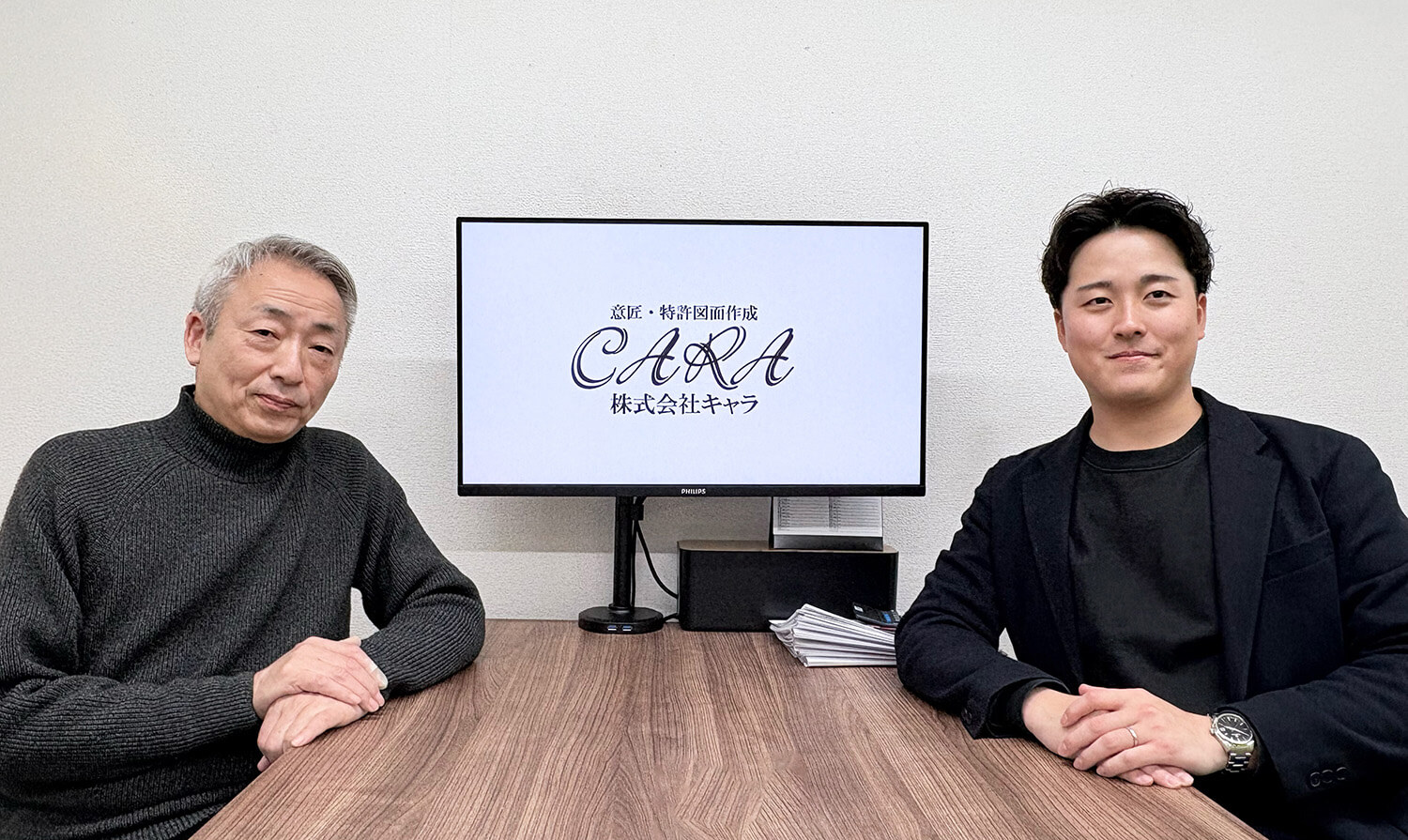
Interviewees
Kara Corporation
Representative Director
Mr. Koji Kanaya
Former Representative
Mr. Shozo Kanaya
Kara Corporation is a group of skilled technicians with over 30 years of experience in creating design and patent drawings. The production of design and patent drawings, essential for patent applications, requires high expertise, accuracy, and speed. As one of the leading specialized companies in Japan, Kara handles numerous patent cases nationwide. This time, we interviewed the current and former representatives about the importance of drawing comparison in this industry and the future use of MIIDEL.
MIIDEL (hereafter M): We have spoken with people from various industries related to drawings, but this is the first time we have interviewed a company specializing in "design and patent drawings." Could you please tell us about your work?
Mr. Koji Kanaya (hereafter Koji, without honorific):Our job is to create drawings and design illustrations that are essential for explaining "which parts of a case are subject to a patent" when filing a patent application.
Patents are composed of the "specifications" created by patent offices and the "drawings" that we create. Since this work only occurs through patent attorneys, it is not widely known to the general public, but even the simplest drawings require accuracy and are legally necessary, so I believe it is a job that will not disappear socially.
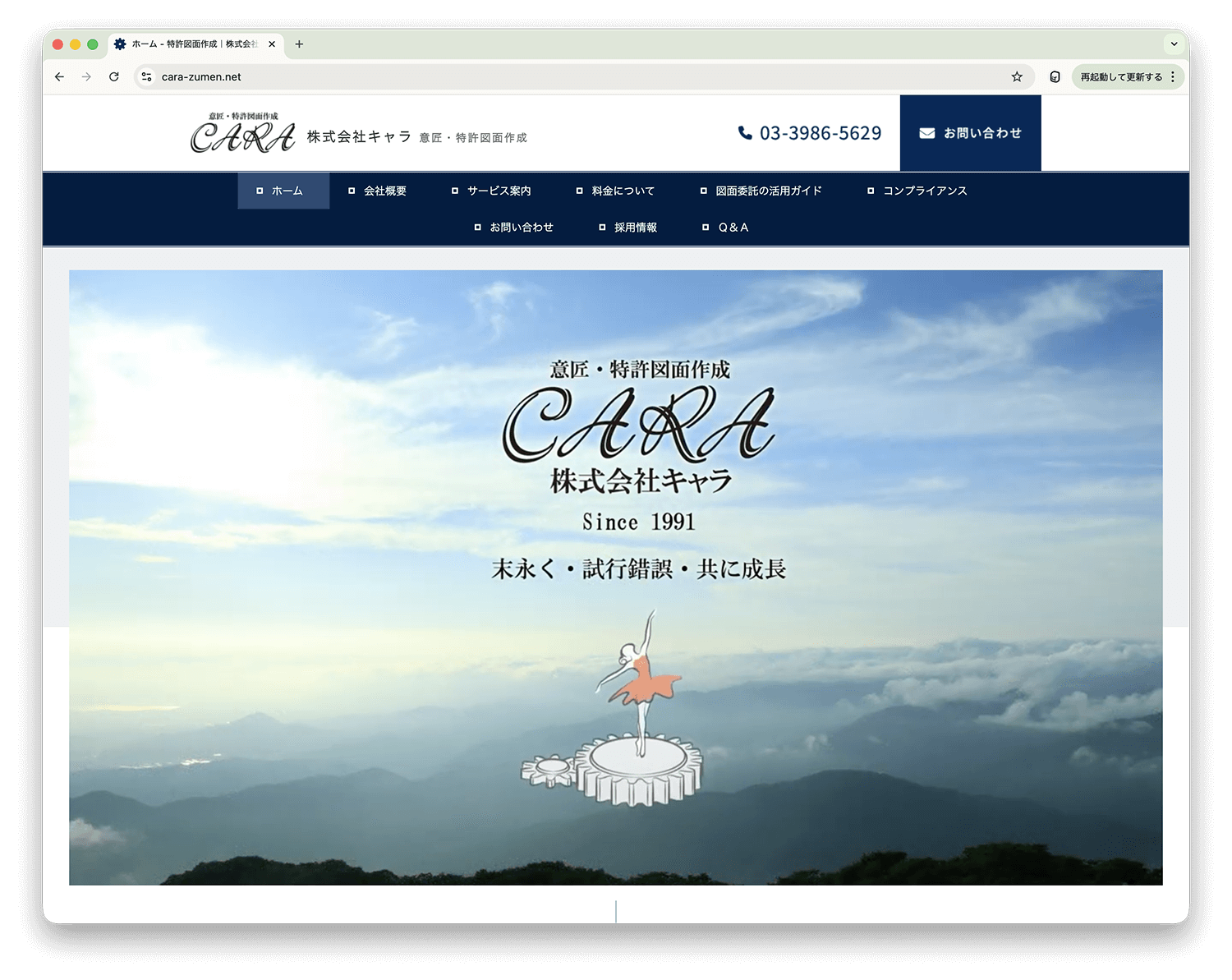
Cara Co., Ltd. website (https://www.cara-zumen.net/ )
M: I see, so the patent examination is conducted based on the drawings created by Cara-san, which means the responsibility is huge. In what form do you receive requests from clients?
Subaru:Most requests come through patent offices, with about 10-20% coming directly from manufacturers. Since the information about inventions is highly confidential, actual drawings are rarely shared; we usually see photos and then create drawings based on them using Adobe Illustrator. It might be closer to technical illustrations than design drawings.
After initially creating the drawings, various exchanges occur regarding corrections related to the core of the invention and changes in notation. Even a single numerical error can affect the examination, and once an application is filed, corrections are not allowed. Many projects have tight deadlines for filing and release dates, often concentrated during busy periods like the fiscal year-end, causing fluctuations in workload. However, the press release date is absolute, so intense work continues until the last moment. We must avoid situations where filing becomes impossible at all costs.
M: Thinking that a mistake could directly affect the client's future rights is nerve-wracking. And if all that pressure concentrates at once...
Subaru:Large patent offices have internal drawing departments, but during busy periods they often outsource to companies like ours. Therefore, capacity during busy seasons is important. We have a history of training staff from inexperienced people, so our staff layer is thick, but the industry overall faces a labor shortage due to difficulty in new entrants. However, the number of projects itself is increasing.
Recently, with an increase in new clients, accurately completing work while adhering to each patent office's unique rules and preferences, such as font usage and line widths, inevitably consumes human resources. So, we were thinking about how to utilize AI, but since we handle information that must not be exposed to the public, we cannot use cloud upload services. Our clients also impose very strict requirements on information management and security.
M: So, the fact that 'MIIDEL' can perform comparisons on a local machine fit perfectly with Cara-san's work.
Subaru:Yes. Like the drawings, the "specifications" created by patent offices are information that must never be fed into generative AI, and the nuance of technical terms can change the scope of rights, so when sending overseas, we spend a large budget to commission intellectual property translation specialists.
By the way, MIIDEL has recently released document comparison software as well, hasn't it?
M: That's 'MIIDEL Docs.' Just as MIIDEL automatically matches similar images to compare drawings, it searches for similar sentences and checks whether they are the same.
Mr. Shozo Kanaya (hereafter Shozo, honorifics omitted)This seems useful for checking changes in specifications as well. When the notation changes or even a single point is modified in the specifications, it becomes difficult to align with the drawings. The drawings also include many items like flowcharts and tables that must be changed simultaneously, but since the drawings are raster images, the checking ultimately has to be done manually.
Subaru:Clients (patent attorneys) want to handle drawings in software they are familiar with, so they request formats like PowerPoint, jpeg, gif, or CAD data. Some even use fax. Accidents can easily happen during file conversions, and if clients edit the files afterward, regressions can occur when related cases arise later... Sometimes we have to trace back one by one to check "When and where did this change?"
Shozo:Even then, we were still printing on paper and checking each item with a pen. It's a niche industry, so it was a leftover analog world.
Patent drawings are special in that they intentionally isolate only the "inventive part" of the overall design. Therefore, the work of creating these drawings and taking responsibility for their accuracy is something that will never disappear as a human job.
M: MIIDEL compares the "as seen" images that are not verbalized or digitized and returns results quickly, but the parts before and after that cannot be automated are truly the work of human professionals.
Shozo:Exactly. Since these are drawings of highly original inventions, AI cannot learn and draw them. So it's faster for humans to draw them. But having help to find mistakes and reduce checking effort is very welcome. We automate as much as possible until the last moment, but the final responsibility always rests with me.
Subaru:By the way, we are currently creating something like this. We plan to present this proposal document to clients to inform them that "from now on, we will strongly reinforce our checking system using MIIDEL."
Currently, patent attorneys have a relatively high average age, so not all are eager to try new things, but improving the accuracy of checks and making results easier to understand is welcomed by clients. Being able to prove that unchanged drawings are "unchanged" is also very beneficial for both parties.
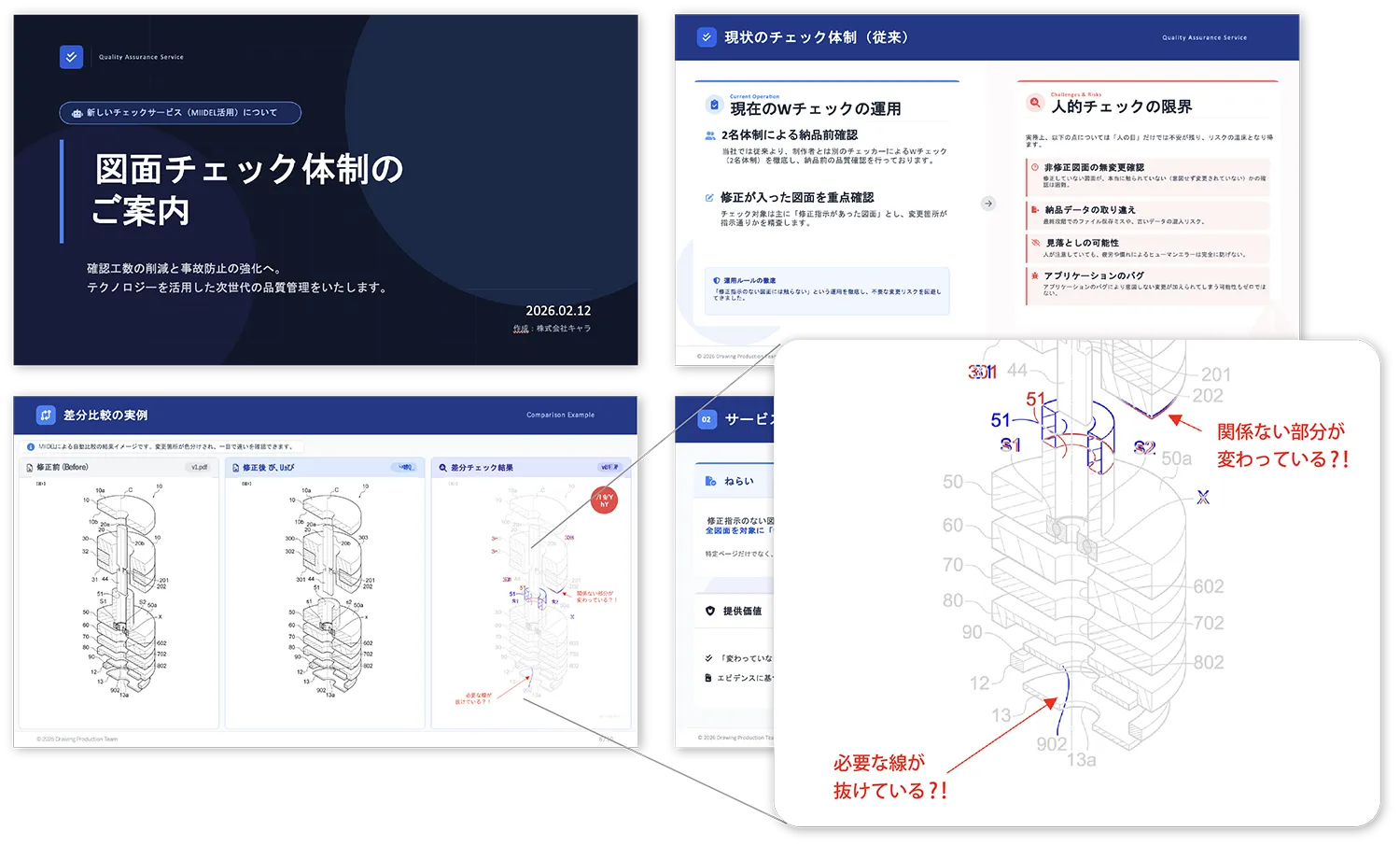
A proposal document created by Cara introducing change point checks using MIIDEL (partial). It clearly illustrates the ease of discovering minor changes and confirming "no changes."
Shozo:Even unintended minor changes like "a line moved a bit where we didn't ask" can cause suspicion of "Where exactly did you touch!?" once discovered. It's important to clearly show that unchanged parts are indeed unchanged.
M: Indeed, some people appreciate MIIDEL because it gives them a sense of having completed the check.
Subaru:That's really true. MIIDEL leaves clear records of results, providing a completely different sense of security. So, through such proposal documents, we want to reassure clients by showing "this is how we check," while also conveying the seriousness of the checking work.
M: I'm very glad you even created a proposal document introducing MIIDEL! By the way, did you consider software other than MIIDEL when introducing it?
Subaru:We didn't consider others. When I first used MIIDEL, I was really surprised and thought, "This is the best!" (laughs). The way it shows differences in red and blue was very easy to understand, and unlike specialized software like Photoshop, anyone can use it, which I really liked.
I use it every day, and I think it will be even more powerful in the final stages of drawing completion at the upcoming fiscal year-end.
M: Thank you. Regarding the future, do you have any requests like "I want more features like this"?
Shozo:Since we often revise the same drawing multiple times or need to go back to related drawings, it would be nice to have change history or version control. Humans are very bad at remembering "Which time did we fix this?" Opening and checking each data one by one is very troublesome, but if we can overview the process of when and what changes occurred, it would help us organize our thoughts and give patent attorneys more peace of mind when writing specifications.
M: I see. Actually, we are also preparing a new tool for "finding similar files from the past."
Subaru:That's very exciting. We also want to continue challenging ourselves by incorporating new technologies like AI, so we definitely want to try using new tools as well.
M: Yes, we will work on development so that we can deliver it to users in the near future. Thank you very much for sharing your valuable insights despite your busy schedule today.
Back to article list