

Customers Review
Customer Voices
The clarity of changes is revolutionary. Looking back, I think, "If only we had MIIDEL then...!"

Daiwa House Industry Co., Ltd.

Interviewees
Daiwa House Industry Co., Ltd. Tokyo Head Office Retail Store Estimation Department
Department Manager
Mr. Mikuni Takayasu
Same Department Section 4
Ms. Tomoi Tomoko
Daiwa House Group is a comprehensive housing manufacturer pioneering industrialized construction, evolving advanced technologies while innovating broadly in housing, retail store, and environmental energy sectors. This time, we visited a team responsible for construction cost estimation* at a large facility development site handled by a group joint venture and interviewed them.
*Construction cost estimation: The task of calculating, item by item, all costs related to materials, work, and personnel based on design drawings and specifications, to estimate the total cost of construction work.
MIIDEL (hereafter M): I heard Ms. Tomoi is the most frequent MIIDEL user in the team. How did you come to know MIIDEL?
Ms. Tomoi (hereafter respectfully):I was looking for a good tool to check drawings for a large project I am currently handling, and a group company already using MIIDEL recommended it to me. When I tried comparing drawings on hand, even drawings that other companies' software couldn't compare well were clearly shown in MIIDEL with simple three-color results: "deletions in blue," "additions in red," and "no changes in gray." I thought this was revolutionary. I discovered fine details I hadn't noticed myself, and I now feel a sense of completion in the drawing check work that used to leave me anxious. I once missed simple numerical changes before, so I sometimes think I wish I had known about it earlier.
M: Even professionals find it difficult to discover all change points without omission, right?
Mr. Mikuni (hereafter respectfully):We take over drawings from the previous stage and perform necessary calculations (counting materials and cost estimation) in the next stage. However, how change points are marked and passed varies by site and location. Also, the design person in charge may be internal or external, with various conditions. Asking the previous stage person each time "What is this about?" "Is this change correct?" is time-consuming, so we want to rationalize the checking process as much as possible.
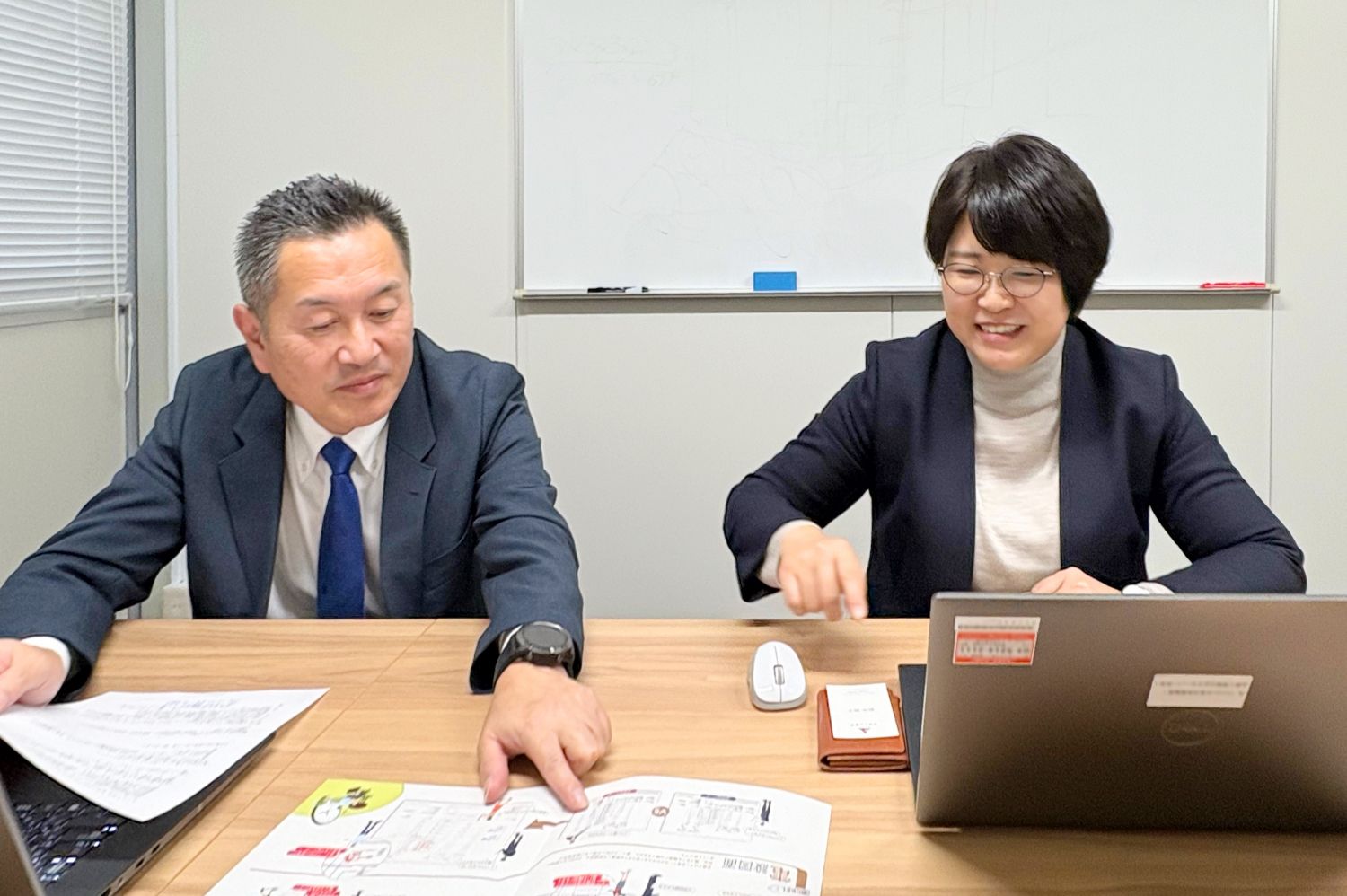
(Photo) Ms. Tomoi (right), the most frequent MIIDEL user, and Department Manager Mr. Mikuni (left)
M: Nowadays, with issues like the 2024 problem, I feel there is growing attention on how the construction industry is implementing DX (digital transformation).
Tomoi:For each project, drawings are checked and recalculated at least five times, but this time there are especially many—400 sheets. Even if a peak of changes suddenly comes, the project schedule is contractually fixed and cannot be delayed. That's why I felt MIIDEL is so attractive I would consider buying it myself.
M: I see, I now understand well how heavy the workload of estimation work is...!
Mikuni:From a supervisor's standpoint, I want to reduce both physical and mental stress and increase engagement in this work. Finding differences in drawings is a simple task. If this can be mechanized and workers freed from it, job happiness will rise, performance will improve, personal career advancement will be supported, and engagement will increase. Also, it allows time to focus on the work that truly matters. Therefore, I see MIIDEL as a tool to make working easier than now.
Tomoi:Actually, I also usually compare old and new drawings with MIIDEL, and I have started overlaying drawings of upper and lower floors to think about "where else can we reduce costs?" This has allowed me to be more creative. Since the cost estimation staff don't use CAD much, it's also nice to be able to easily perform such (three-dimensional) verification using PDFs.
M: You are also researching how to use it, right? Does the cost estimation work require experience at construction sites as well?
Tomoi:I transferred from another housing manufacturer and now work at this company. Since the materials used in housing and general construction differ, I sometimes visit the site to study and understand how things actually are. Cost estimation staff don't often have opportunities to be on site unless they do so proactively.

(Photo) Scene of confirming the property at the construction site
M: Indeed, there are many stakeholders and processes, and it seems that imagination about "what will happen in the next stage" is also required.
Mikuni:Cost estimation means that even the same person looking at the same property (drawing) can have different results depending on the day. That shows how many perspectives need to be considered. But if even one thing is wrong, many parts have to be corrected. Especially this project is complicated with intertwined contract forms. So I thought it would be risky if no one consistently handled this work, and we decided to dispatch a dedicated team. We also expect MIIDEL to be effective here in the future.
Tomoi:The other day, we shared the MIIDEL results directly with an external party we had requested for quantity takeoff*, and they were able to complete the work in three weeks. Without MIIDEL, it would not have been possible to finish in such a short time. This work requires mutual accuracy, and I feel that such collaboration has also improved.
M: That is a delightful story! We will continue to strive to improve the software's accuracy and usability to contribute to better working styles for everyone in the construction industry. Thank you very much for today.
*Quantity takeoff: The task in cost estimation work of extracting elements and quantities such as materials, personnel, and heavy machinery that form the basis for cost calculation.
Back to article list