

Customers Review
Customer Voices
Adopted MIIDEL with intuitive operability without hesitation. Drawings, forms, and sudden revision tasks are definitely easier!
Musashi Seimitsu Industry Co., Ltd.
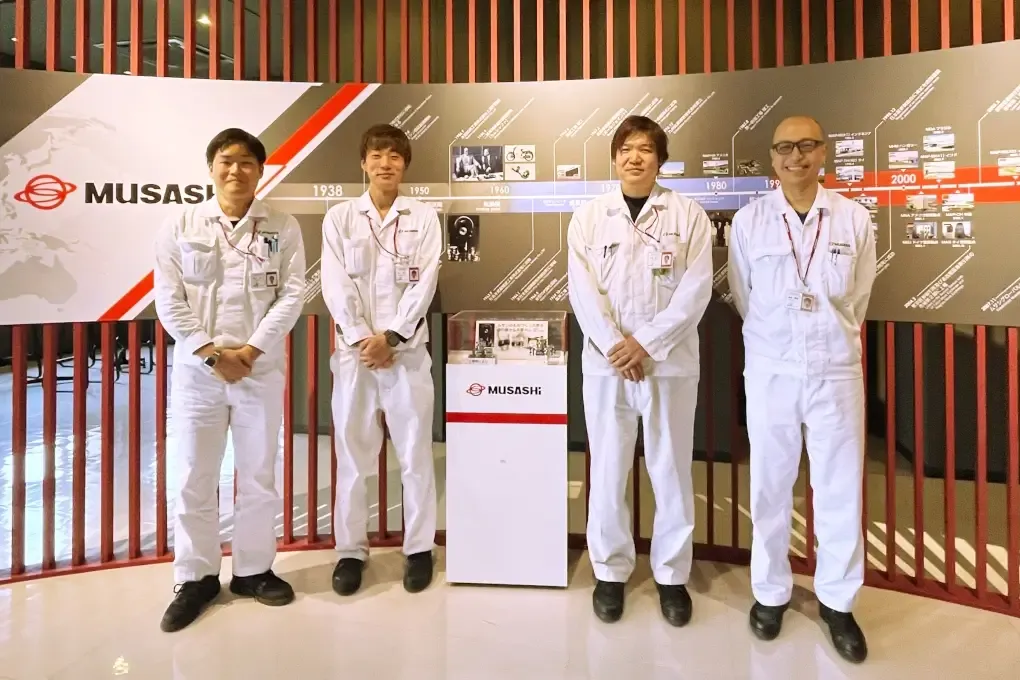
Interviewees
Musashi Seimitsu Kogyo Co., Ltd. PT-GB Division GB Manufacturing Technology 2 Group
Group Manager Mr. Akitaka Eto
Mr. Takashi Saito
Mr. Takeshi Fujita
Same GB Manufacturing Technology 1 Group
Mr. Yuki Nagayama

Musashi Seimitsu Kogyo Co., Ltd., founded in 1938, is a world-class manufacturer of automotive and motorcycle parts specializing in powertrain and chassis component development and manufacturing. We spoke with those using MIIDEL in the manufacturing process of precision parts.
MIIDEL (hereafter M): How do you usually utilize MIIDEL at Musashi Seimitsu Kogyo? Is it mostly for checking old and new manufacturing drawings?
Mr. Saito (hereafter without honorific):Yes. Some customers provide paper drawings, so we compare not only electronic drawings but also scanned PDF data of drawings with handwritten comments. Scanned ones may be distorted upon receipt, but we must responsibly check what we receive from customers. Before MIIDEL, we paired original drawings with copies and double-checked the copies with red and blue pens. Now, we attach MIIDEL comparison results to the original drawings and circulate them for approval. It’s easier because you can approve reliably just by looking at the results. Also, we use it not only for drawings but also for revision checks of forms linked to drawings.
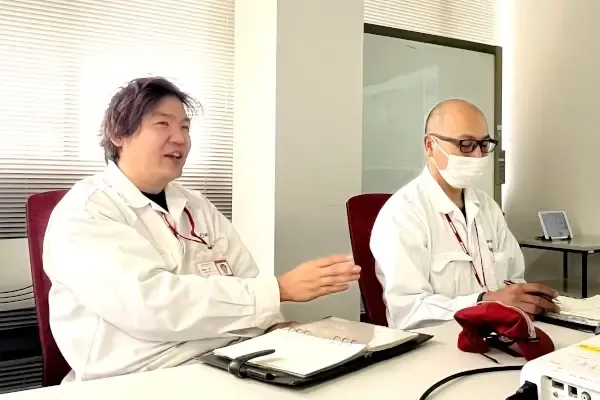
The two (Mr. Saito and Mr. Eto) who considered improving drawing check work, researched on the web, and encountered MIIDEL
M: How often do revisions of forms occur?
Mr. Nagayama (hereafter without honorific):There are peaks and valleys. Sometimes there are none at all, but when they occur, it’s dozens of sets at once. If the customer changes standards or notations, all parts for that customer change.
Saito:When there are changes, there are related forms within the company, so the forms linked to drawings, forms below those, and even further down... everything must be linked across multiple levels.
M: When the peak of work comes, it seems it might affect other jobs. Are such reviews regular or without notice?
Saito:Checks without notice occur when necessary. In addition to such irregular reviews, there are also regular audits. The automotive industry’s work system is formed according to IATF* standards, and when form notations are changed, multiple, sometimes dozens of parts have form change points. Previously, even a single difference required us to search diligently across everything.
Nagayama:Before, when we found a mistake, we thought 'This is the worst...!' but now it’s definitely easier (laughs).
M: What was the deciding factor for introducing MIIDEL?
Mr. Eto (hereafter without honorific):I once investigated problems within the department, and the issue of all drawing and form checks being manual came up, so we decided to do something about it. I consulted with Saito, gathered information on various tools, narrowed it down to three products including MIIDEL, and tried them all. We made a table of desired functions and operations and evaluated what was possible or not, and the result was MIIDEL without hesitation. Other products had too many buttons making it hard to find what we wanted, or required many detailed settings. MIIDEL was overwhelmingly better in usability.
Saito:The feature to cut out part of a drawing, move it anywhere, and have it automatically snap to the comparison target was also a good point. Drawings often change layout due to changes in associated information like dimension lines. The position of tables may change to make space for additional parts, or the content may be exactly the same but only the layout changes. The ease of such comparisons was one of the strong reasons we recommended it. Also, I was surprised by how quickly MIIDEL evolves. It’s been a year since introduction, and functions have increased and usability improved during that time. This was a pleasant surprise not included in the evaluation criteria.
M: Thank you for choosing MIIDEL among many candidates. It’s helping improve work efficiency compared to when it was manual.
Nagayama:The two of us (Mr. Nagayama and Mr. Fujita) use it the most, and one person's work time is at least less than half (even with operations like cutting and corrections). If comparing electronic data, it’s even faster.
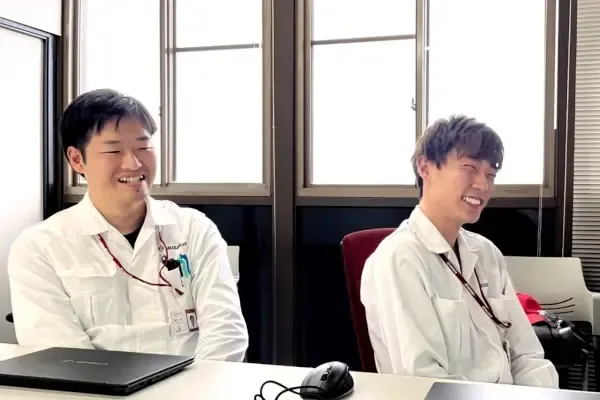
The two (Mr. Fujita and Mr. Nagayama) who use MIIDEL the most in the group
Mr. Fujita (hereafter without honorific):The more sheets you compare at once, the more beneficial it is. Previously, we also did double checks, so the time doubled and doubled.
Eto:Not only for improving traditional work efficiency, but also for things like reviewing drawings for estimate revisions or small confirmations.
Nagayama:I also use it not related to checks or approvals, but to understand specification differences of similar parts for my own work. Also, it’s good for seeing what changed in a PowerPoint edited by someone. Since it’s electronic data with consistent paper size, it’s very easy to understand.
M: That’s amazing! Everyone is really using it daily.
Fujita:Just by watching the users, I could use it intuitively without looking at manuals. Satisfaction is high.
Saito:It’s nice to see that with each version update, it evolves responding to user requests, showing that our opinions are taken into account. We look forward to version 8.
M: Thank you! It excites me to think that we can support professional work requiring precision and rigor, even in part. Thank you very much for today.
*IATF stands for International Automotive Task Force, also known as the "International Automotive Industry Special Committee." The "IATF16949 certification system" operated by this organization is an international standard for quality management systems specialized for the automotive industry, distinct from ISO9001 and others.
Back to article list